

- Reference # H.5.1718035
- Project Status Current
- Timeframe 3 years
- Project manager Sarah Docherty
- CRCNA Funding $800,000.00
- Total project value $1,636,362.00
- Project research participant Marthakal Homeland and Resource Centre Aboriginal Corporation
- Research Programs 5. Northern health service delivery innovation
- Location Thursday Island, Mt Isa , Brisbane, Nhulunbuy, Galiwinku, Darwin
- Health service delivery
Summary
A new eye screening service and delivery model will enhance the effectiveness of remote health service delivery, optimise health spending and ‘reduce the gap’ in health outcomes for people in remote areas, particularly for those at risk of blindness from underlying conditions, like diabetes.
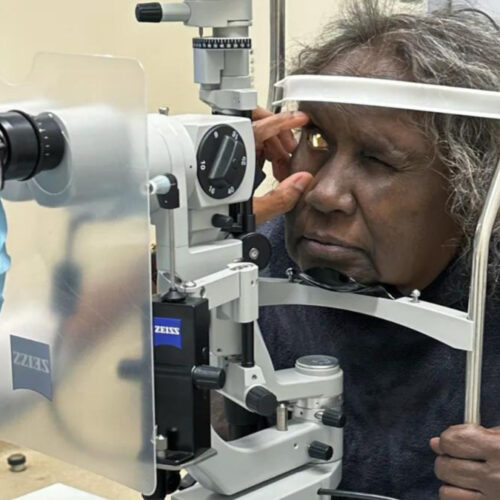
This project will implement retinal screening using a telehealth platform developed by CSIRO, where health workers will be trained to use retinal cameras to take photos of patients’ eyes in remote communities. Ophthalmologist teams based in larger regional centres, will access this information via web-based technologies and provide review and diagnostic services.
The lessons learned from this research will be used to develop a new and innovative model of care for the delivery of remote health services, which will be applicable to broader health initiatives in remote communities.
Expected outcomes
- Screening and early detection of diabetic retinopathy will prevent blindness and close the gap in providing specialist eye care to rural and remote Northern Australia and is expected to have a cost impact of $2.4 million per annum.1
- Building capacity of Northern Australian healthcare workforce to perform eye screening tests which may be expanded to include other eye diseases is expected to have a cost impact of $12 million per annum.
- Cost savings due to reduced travel: $6.4m pa.2
- An increased ability to build relationships between remote communities and wider public health agencies.
- An increased opportunity for employment as well as expanding the skills of the Northern Australia workforce.
- Increased uptake of high-end remote technologies in remote areas using telehealth.
1 Impact cost is based on earlier diagnosis and prevention of vision loss in 1% of the population living in 7 remote communities of ~1200 people each @ $29,000*/patient. Source: Access Economic calculations, June 2010.
2 Estimated at $800/trip based on Qld Patient travel subsidy scheme.
Publications
29 September 2022
Establishing eye screening services to prevent avoidable blindness in remote Northern Australian communities
Type: Report
Industry: Health service delivery