


- Reference # H.5.2021068
- Project Status Current
- Timeframe 3 years
- Project manager Ian Biggs
- CRCNA Funding $750,000.00
- Total project value $1,862,822.00
- Project research participant University of Western Australia - The Rural Clinical School of Western Australia
- Project research co-funder Tropical Australian Academic Health Centre Ltd (TAAHC)
- Research Programs 5. Northern health service delivery innovation
- Location Townsville, Cairns, Torres Strait, Weipa, Mt Isa, Longreach, Mackay, Rockhampton, Darwin, Broome
- Health service delivery
Summary
This project aims to improve the responsiveness of health services to the health needs of communities in the North Queensland region. The primary research question is: How do we best develop and implement integrated place-based planning to the unique contexts of northern Queensland?
Why is this study needed?
Investing in the health workforce and related improvement in models of care can be a strong economic pillar supporting sustained prosperity. A healthy community is a necessary to ensure stable local communities that will enable continued regional economic development. There are many similarities in health challenges and service delivery across northern Australia, with small, dispersed populations in challenging geographies. Despite this, lack of coordination in planning and delivery of health services across the spectrum from community to primary to hospital care leads to inefficiencies, duplication, gaps and less than optimal health and economic outcomes. This project provides a unique opportunity to unite health industry partners and engage with local communities to improve efficiencies and effectiveness in service planning and delivery.
How will the study be conducted?
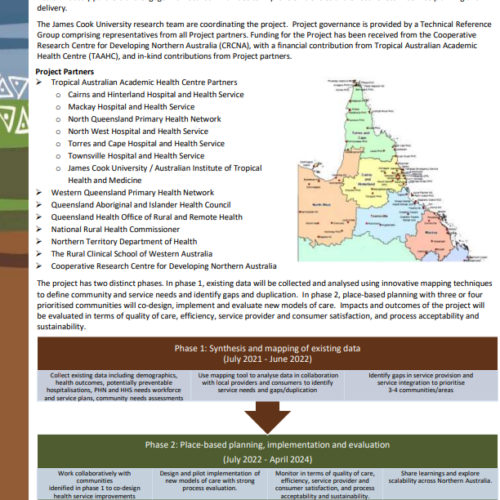
The project has two distinct phases. Phase 1 involved the synthesis and spatial mapping of existing, publicly available data to create the Northern Queensland Health Atlas. The Atlas is an online, interactive map which visually displays population and health data, health services available and workforce information. Various indicators can be selected and overlayed to visualise, and facilitate consideration of, unmet need or gaps in services or workforce. Explore the Atlas here.
A gap analysis was undertaken to facilitate a broad understanding of unmet health need in the project region. It took a pragmatic approach drawing on key principles of health care equity to develop a composite Index of Unmet Need. The Index included indicators of known determinants of health, current and projected health need, service need, workforce and geographic access. The Gap Analysis of Health Needs and Services in the Northern Queensland Region Report is available upon request.
The Atlas and Gap Analysis were used to guide consultation with stakeholder groups in the prioritisation of communities across the region to engage in place-based health planning processes in Phase Two of the project. Further consultation will be undertaken with local stakeholders in the prioritised communities to co-select three to four communities to participate in Phase Two.
In this phase, place-based planning with the communities will involve co-design, implementation and evaluation of new or modified models of care. Impacts and outcomes of the project will be evaluated in terms of quality of care, efficiency, service provider and consumer satisfaction, and process acceptability and sustainability.
Expected outcomes
The project is expected to deliver impact in terms of improved health and wellbeing of the north Queensland community, as a direct result of the project activities through more effective, re-designed health care delivery. This will be measured and costed in terms of population level measures of health and wellbeing (physical and mental health) in the four localities of co-design as well as the impact in terms of potentially preventable hospitalisations. In addition, it will develop the capabilities of local service providers and communities to engage in participatory processes to improve care.
It will also deliver increased gross domestic product in Northern Australia, with three mechanisms for economic impact of this body of work that can be costed.
- Direct return on investment from place-based planning models strengthening Primary Health Care. Based on NT work, each $1 invested in PHC is likely to generate $4-12 in returns beyond the direct health benefits (Zhao et al., 2014).
- Healthier populations more able to work and thus generate more GDP.
- Stronger learning health systems will attract more health and research investment to NA that in turn increases GDP. The return on investment from health research investment in northern Australia has been calculated at $3.90 per every $1.00 invested (KPMG, 2018). Thus this project itself, through injecting an extra $2m into the NQ setting, could leverage a ROI of $7.8 million.
- This project will also effectively generate and fund 10.6 person years of employment to conduct the research as described, with additional spin off impacts in terms of support to transport, accommodation and hospitality industries as well as education and training.
Publications
9 August 2021
Integrating health care planning for health and prosperity in north Queensland
Type: Fact sheet
Industry: Health service delivery