

Establishing eye screening services to prevent avoidable blindness in remote Northern Australian communities
- Reference # H.5.1718035
- Research Programs 5. Northern health service delivery and models of care
- Project Timeframe 4 years (2018 to 2022)
- CRCNA Funding $800,000
- Total project value $1,636,362
- Health service delivery
- First Nations led business development
Project locations: Thursday Island, Mount Isa , Brisbane, Nhulunbuy, Galiwin'ku, Darwin
Project partners: CSIRO ; Queensland Department of Health ; Laynhapuy Homelands Aboriginal Corporation ; Marthakal Homeland and Resource Centre Aboriginal Corporation
Project summary and impacts
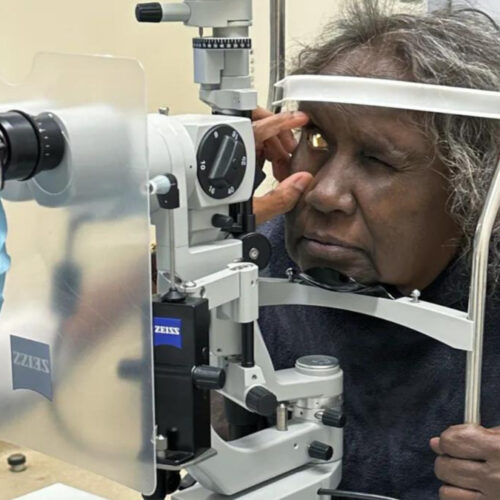
This project established an innovative eye screening and telehealth service that is improving access to specialist eye care in remote communities across northern Australia. Led by CSIRO and partners, the project combined portable retinal imaging technology, artificial intelligence (AI) and telehealth to enable local health workers to screen patients for eye disease and connect them with specialist ophthalmologists for rapid assessment and treatment.
The project responded to the significant burden of vision impairment among Indigenous Australians, who experience blindness and vision loss at three times the rate of non-Indigenous Australians. By allowing retinal images to be securely captured in remote communities and assessed remotely using AI-supported diagnostic tools, the model improved access to early detection and treatment of diabetic retinopathy and other vision-threatening conditions.
The project screened more than 1,000 patients across remote Queensland regions in 2022–23, identifying over 220 serious eye disease cases in a single year. It trained 40 healthcare workers in eye screening techniques, strengthened local health service capability and improved the adoption of telehealth technologies by clinicians.
The benefits have been substantial. Earlier detection and treatment have reduced avoidable blindness, improved quality of life and generated significant economic savings through reduced patient travel and lower health system costs. The project has also created a scalable model for AI-enabled healthcare delivery that can be adapted to detect other eye conditions and support a wider range of telehealth services across remote northern Australia.
By combining technology, specialist expertise and community-based healthcare delivery, the project has demonstrated a practical pathway to closing the gap in eye health outcomes and preventing avoidable blindness in remote and Indigenous communities.
Publications

17 November 2025
Impact report: Establishing eye screening services to prevent avoidable blindness in remote northern Australian communities
Type: Report
Industry: Health service delivery
29 September 2022
Establishing eye screening services to prevent avoidable blindness in remote Northern Australian communities
Type: Report
Industry: Health service delivery
23 December 2020
Establishing eye screening services to prevent avoidable blindness in remote Northern Australian communities: Lessons learnt to date – What have we learnt 2 years in?
Type: Report
Industry: Health service delivery
News

29 August 2018