


- Author NT Government
- Publish date 30 April 2026
- Type Report
- Documents
- Cotton Grains Cattle program
- Broadacre cropping
Summary
Designed as a quick and easy reference, the field guide supports producers, agronomists and industry advisors to precisely identify weeds at both seedling and mature stages. Accurate weed identification is the first step in effective control and helps producers make informed management decisions to protect crop yields and sustainability.
Developed by the NT Government’s, Department of Agriculture and Fisheries (DAF), the guide features photographs and descriptions of more than 50 common weed species found in NT crops, including grasses, broadleaf weeds and sedges.
Hard copies are available at local NT Dept Agriculture and Fisheries or NT Farmers offices.
This publication is an output of the CRCNA Cotton, Grains, Cattle Program – Fundamentals of sustainable NT cropping project.
Projects
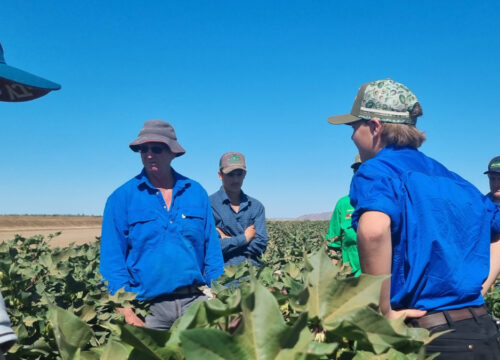

Cotton Grains Cattle program: Addressing the fundamentals of cropping-systems in the Northern Territory
Improving the productivity and profitability of the Northern Territory’s cropping system is crucial for the sustainable growth of the regions agriculture sector. Current research and development efforts, along with major infrastructure investments, are supporting the establishment of a self-sustaining cotton industry in the Top End. However, significant knowledge gaps remain in areas such as crop establishment, agronomy, biosecurity, technical skills, and the social factors that present barriers to the growth of broadacre cropping in the Northern Territory. These gaps must be addressed for the sector to fully realise its potential. This project will integrate cropping trials with efforts to characterise and map soil types and water-holding capacity at participating trial sites, as well as in new potential cotton-growing areas across the Northern Territory. Scenario planning will also be conducted to better understand the economic and environmental impacts of the project’s recommendations. Practice change, guided by the knowledge co-generated throughout the life of the project, will lead to sustainable social, environmental, and economical impacts. Specific outcomes include: Growers confidently adopting crop establishment recommendations for reliable production. Growers making informed decisions on crop rotation and cover crops to maximise production and profitability. Growers making informed and conscious decisions regarding nutrition application and the selection of integrated pest management (IPM) strategies for insect and disease control. Current growers and potential investors in the Northern Territory having access to adequate information for selecting suitable crops for new establishments. Growers having access to a decision-making toolkit that supports investment in the industry, including risk management planning. Aboriginal land councils, Aboriginal development corporations, and Indigenous communities being supported through access to information that informs investment in broadacre cropping, capacity building, and other identified needs. The scientific and commercial communities accessing trusted information from the project’s trials. The Northern Territory cotton industry having access to tailored training materials for ongoing reference and capacity building. Publications Scoping mushroom cultivation in the Northern Territory: Applying a circular economy approach https://www.sciencedirect.com/science/article/pii/S294975072500104X Challenges and prospects of cotton farming in the tropics: lessons for northern Australia https://link.springer.com/article/10.1186/s42397-025-00249-7