

- Author Bennett, D., Dickinson, G., Department of Agriculture and Fisheries Queensland
- Publish date 16 May 2021
- Type Report
- ISBN 978-1-922437-23-5
- Documents
- Horticulture
Summary
A comparison of the profitability of conventional (low, medium & high density) and trellis (high density) mango canopy systems in north Queensland based on early trial results
A key priority for the Australian mango industry is to increase industry productivity through increased yields and reduced input costs. The adoption of high density orchard systems by other tree crops has successfully improved the profitability of these industries and there is potential for these systems to also improve profitability of the mango industry.
This economic case study compares discrete farm level investments in conventional low, medium and high density canopy systems and a trellis high density canopy system for mango production in north Queensland.
The study aims to determine whether the extra investment required to implement medium or high density mango orchards is likely to return a higher gross margin, compared to conventional low density orchards, using the B74 (Calypso®) variety. Data were sourced from the DAF Planting Systems Trial at Walkamin, in far north Queensland.
Three key outcomes were identified:
- the calculation of establishment costs/hectare for the four canopy systems
- that higher density orchards achieve much higher annual gross margins/hectare (difference between annual gross revenue and annual variable costs) than lower density orchards
- that the cumulative nett cash flow/hectare became positive across all four systems at a relatively young age (4 years for conventional high density, 5 years for conventional low and medium density and 6 years for trellis high density), but then rapidly accelerated in the systems with increased planting density and intensification.
Overall, this case study concludes the adoption of higher density planting densities requires a higher level of investment during establishment and the first 10 years – but these costs are rapidly recouped by the higher revenues achieved by increased yield per hectare.
Additional benefits of high density systems also include improved cyclone resilience, spray efficiency and greater application for new technologies such as automation and robotic harvesting.
Projects

Transforming mango futures
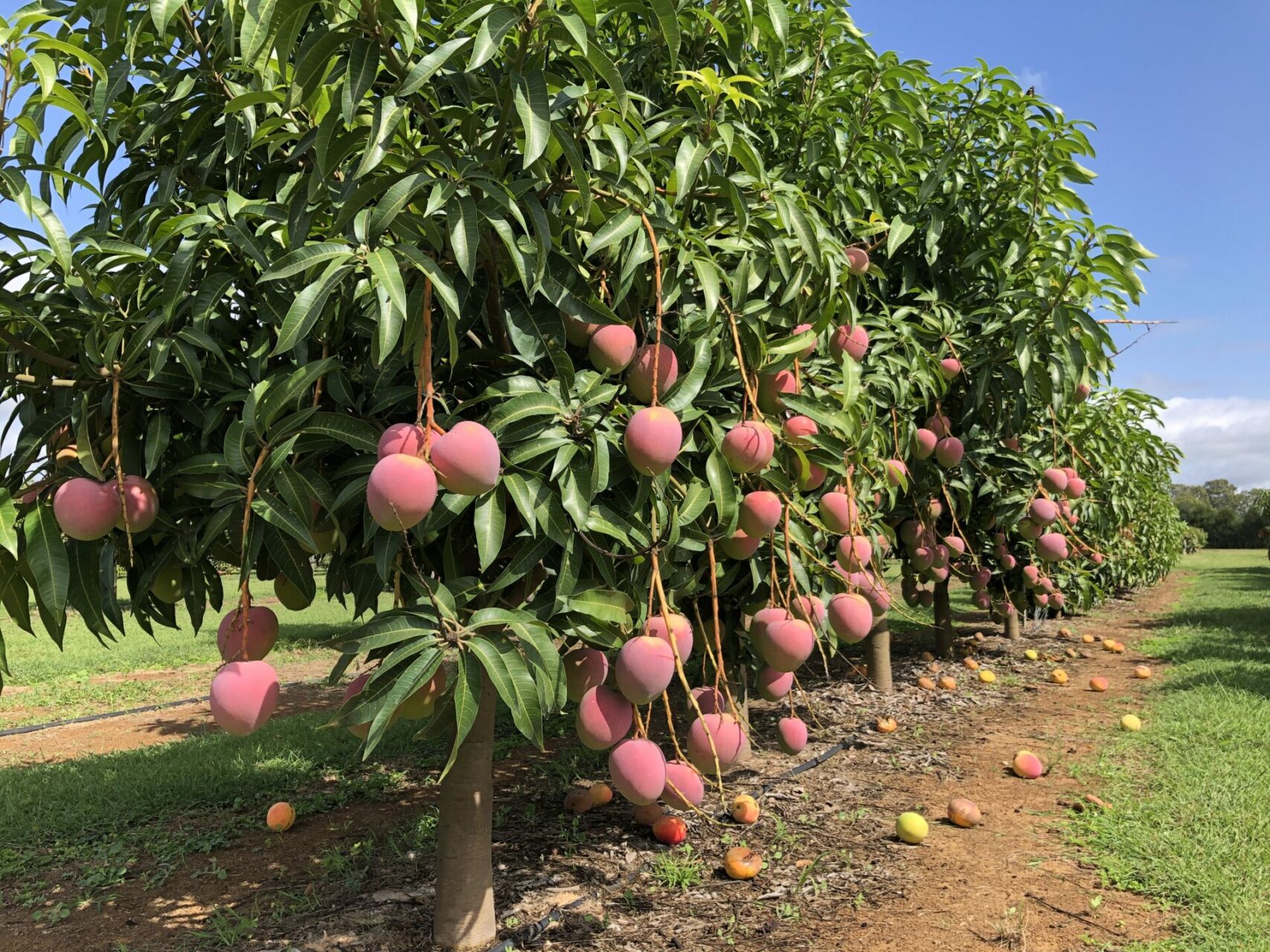
The Transforming Mango Futures project helped build the foundation for a more productive and profitable Australian mango industry by testing intensive orchard production systems under commercial conditions in Queensland and the Northern Territory. Delivered by the Department of Agriculture and Fisheries in partnership with industry growers and the Australian Mango Industry Association, the project established demonstration trials of high-density trellised and non-trellised systems using established and emerging mango varieties. The project produced practical resources to support grower adoption, including technical manuals, economic case studies and instructional videos, alongside field days and industry engagement activities that built grower capability in orchard establishment and management. The project also strengthened collaboration between industry, researchers and government, with momentum continuing through follow-on investment in the Transforming Orchard Futures initiative. Economic modelling indicates widespread adoption of intensive production systems could deliver substantial long-term cost savings and support new orchard investment across the Australian mango industry. Online resources: Australian Mangoes Resource Library: https://www.industry.mangoes.net.au/resources/resource-library/?category= Australian Treecrop Magazine: https://www.treecrop.com.au/news/record-yield-mango-high-density-planting-trial/ Three videos were produced which cover the key concepts and skills required to manage high density mango systems: High-density mango intensification: the basics High-density mango orchards: espalier trellis High-density mango orchards: slim hedges.