

- Author Matt Osborne et al
- Publish date 13 November 2019
- Type Presentations
- Documents
- Aquaculture
- First Nations led business development
- Strategic policy development
- Supply chain development
Summary
Authors: Matt Osborne (NT DPIR) and Bunug Galaminda (Yagbani Aboriginal Corporation)
Delivered 13/11/2019 at the Territory NRM Conference, Darwin.
Projects

Northern Territory Tropical Rock Oyster research and development
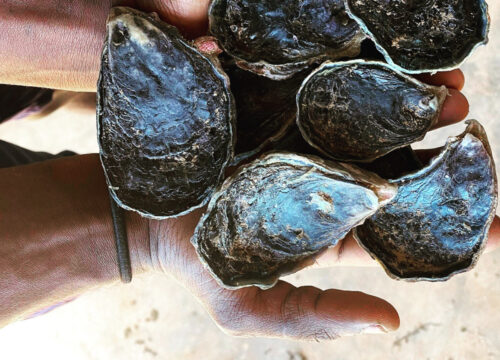
This project establishes a collaborative cross-jurisdictional approach to address the most significant technical and regulatory issues which are confronting northern Australia’s fledgling Tropical Rock Oyster (TRO) industry. The project work will be conducted by research teams in Western Australia (A.2.1819053WA) and the Northern Territory and include three sub-projects addressing the different research needs identified. These are outlined below. Sub-Project 1 – Species Identification, Pathogen Screening and Translocation Risk assessment (NT) This research will standardise oyster common names and assess the need for farming and translocation zones across NA. It will consider risks associated with genetic pollution of wild populations, existing information on tropical ecosystems and oyster diseases, experiences from the pearl industry, and existing practice in edible oyster aquaculture in other regions of Australia. This information will provide a strong science base for biosecurity planning, management and operating procedures for the developing industry and determine key issues for further research and development. Sub-Project 2 – Securing commercial spat (juvenile) supply Early hatchery development work in the NT and WA indicates Tropical Rock Oysters have different larval requirements to the well-studied and already commercially produced Sydney Rock Oyster (SRO) and Pacific Oyster (PO). Therefore, the hatchery manuals developed for SRO’s and PO’s are not effective in producing commercial quantities of TRO spat. Researchers will utilise existing hatchery infrastructure and expertise at the Darwin Aquaculture Centre to refine culture techniques for the Blacklip Rock Oyster. Hatchery trials will be conducted to refine and improve larval settlement procedures and will include experiments on different salinities, the timing of settlement and the effectiveness of chemical and substrate settlement cues. Work on conditioning broodstock within the hatchery and investigating which hatchery systems work best will also form part of this sub-project Sub-Project 3 – Optimisation of grow-out methods and gear technology This Sub-Project will investigate optimised grow-out methods and gear technology for the production of Blacklip Rock Oyster. Farming trials will be conducted using intertidal systems at two sites: South Goulburn Island (supported by the Yagbani Aboriginal Corporation) and Groote Eylandt ( supported by the Anindilyakwa Land Council). The two trials will include: Trial 1 will use one manufacturer type to investigate the effect of three different basket heights in the tidal range (standard, low and dynamic) and density (standard and half of standard) of oysters in baskets on growth and survival of oysters and the biofouling of the baskets. Growth rates, shell shape, survival and biofouling will be recorded. Trial 2 will compare the performance of different gear types in producing marketable Blacklip Rock Oysters. This trial will provide data on oyster growth and shape and qualitative information on the operation, maintenance and performance of the different systems.