


- Author Bhattarai, S., Trotter, T., Thomson,T
- Publish date 10 February 2021
- Type Report
- Documents
- Broadacre cropping
Summary
This report provides the results of the first year of multi-location trials of three fennel genotypes grown at four locations across Queensland (Tully, Ayr, Rockhampton and Biloela) and in Darwin and Katherine in the Northern Territory.
It covers the in-field crop agronomy and the results of the yield and quality analysis, undertaken by research lead, CQUniversity.
The seed yield of the three fennel varieties across each of the trial locations, ranged from 50 to 1574 kg/ha, with the highest seed yield recorded in Ayr followed by Katherine and Rockhampton, and the lowest yield recorded in Biloela.
Researchers have concluded in order for fennel to realise its potential as a high-value crop in Northern Australian conditions, additional research is required to optimise the time of seeding for different locations, agronomy for developing the planting density, and crop adaptation under different farming systems. These need to be assessed alongside assessment of the impact of variables such as tillage, previous crops and fertiliser regimes, and the impact of previous season herbicide applications.
Projects

Spicing up Northern Australia with high-value condiment crops
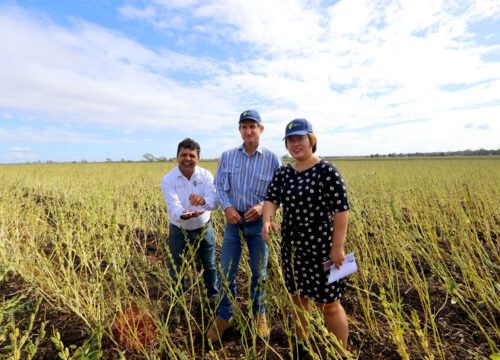
The Spicing up northern Australia with high-value condiment crops project explored the potential for establishing a new high-value spice industry across northern Australia. Funded by CRCNA and delivered by CQUniversity Australia in partnership with AgriVentis Technologies Ltd, the project evaluated the agronomic performance, commercial viability and market opportunities for a range of spice and condiment crops suited to northern farming systems. Over three years, field trials were conducted across Queensland, the Northern Territory and Western Australia, progressing promising crops through varietal evaluation, verification and commercial-scale production trials. The research identified black sesame, fennel and kalonji as the most suitable crops for northern Australian conditions, with black sesame demonstrating strong adaptability across multiple production regions and seasons. The project generated valuable production, market and supply chain knowledge, providing growers with evidence-based information on incorporating high-value spices into existing crop rotations. It also highlighted key barriers to commercial expansion, including mechanised production systems, pest and weed management, and post-harvest processing requirements. The findings laid the foundation for the follow-on Great Northern Spices program, supporting continued industry development, grower adoption and investment in new agricultural opportunities across northern Australia.