

- Author Dr Michael Considine
- Publish date 2 November 2026
- Type Report
- ISBN 978-1-7639362-6-3
- Documents
- Horticulture
- Agriculture
Summary
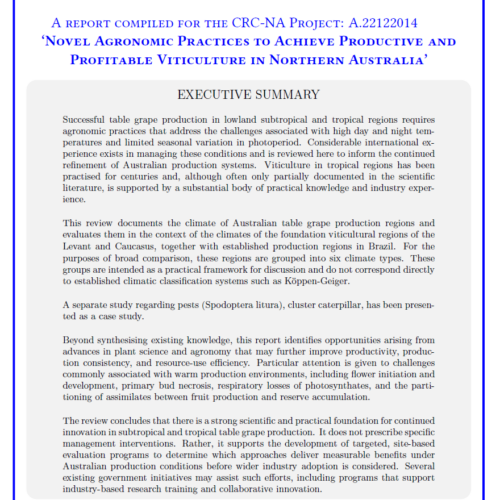
This report explores the opportunities for developing and expanding table grape production in northern Australia, with a focus on industry growth, market demand and export potential.
It examines the region’s competitive advantages, including climatic conditions and opportunities for early-season production, alongside key challenges relating to production, infrastructure, supply chains and market access.
The report provides insights to inform future research, industry investment and development priorities, supporting a more competitive and sustainable table grape industry in northern Australia.
Projects

Novel agronomic practices to achieve productive and profitable viticulture in northern Australia (Table Grapes)
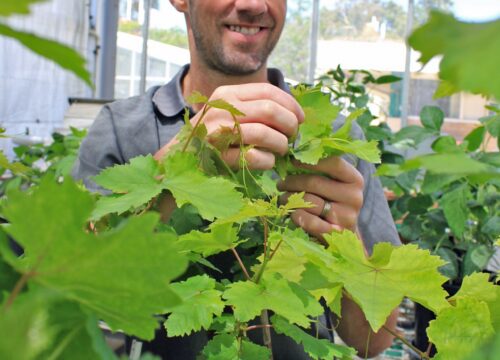
CRCNA-supported research has delivered new knowledge and practical recommendations to improve the productivity, profitability and sustainability of table grape production in northern Australia. Led by The University of Western Australia in partnership with the WA Department of Primary Industries and Regional Development and Fresh Produce Group, the project investigated the climatic, physiological and pest management challenges affecting table grape production in the Kimberley and Gascoyne regions of Western Australia. Research examined grapevine responses to high temperatures, water use, dormancy and flowering, alongside alternative agronomic practices including irrigation, pruning and plant growth management. A significant outcome was the development and trialling of alternative pest management approaches, including pheromone-based mating disruption technology targeting Spodoptera litura. The research supported reduced chemical pesticide use, lowering production costs and potential risks to farm workers while improving understanding of pesticide resistance and beneficial insect populations. The project also contributed to increased vine productivity. Beyond the farm, the research strengthened northern Australia’s horticultural research capability, supporting six postgraduate research projects, generating scientific publications and establishing new industry collaborations. The project has delivered at least a twofold return on CRCNA’s $1.04 million investment to date and created a foundation for further research, improved grower practices and potential commercialisation of new pest management technology. Publications from this project: Dewi JR, Foyer CH, Considine MJ. Reactive oxygen species, antioxidants and the redox regulation of bud quiescence. FEBS Letters. https://doi.org/10.1111/febs.70678 Dewi JR, Poudel P, Xu W, Signorelli S, Considine MJ. Optimization of ascorbate and glutathione assays for woody perennial bud tissues: overcoming matrix effects and storage instability. Tree Physiology 46, tpag103. Hermawaty D, Clode PL, Considine JA, Signorelli S, Considine MJ. Growth competence develops independently of cell division: uncoupling dormancy and cell cycle in grapevine buds. Annals of Botany, mcag218. Signorelli S, Velappan Y, Hermawaty D, Feil R, Couture C, Considine JA, Lunn JE, Considine MJ. Seasonal changes in the physiology and metabolism of grapevine latent buds. Journal of Experimental Botany 77, 1756–1772. Khan FS, Considine MJ, Can W, Xu Z, Zhang H. From morphology to epigenetics: current understanding of the floral regulation in woody perennials. Plant Physiology and Biochemistry 227, 110192. Song X, Liu Y, Meng X, Chen S, Sang K, Zheng Q, Zhou Y, Considine M, Yu J, Xia X. Warm temperature activates the TCP15-HDA4 module to suppress shoot branching through promoting auxin biosynthesis and signaling in tomato. Molecular Plant 125, e70735. Considine M. Quiescence and dormancy underpin plasticity and resilience: the virtue of being idle. Journal of Experimental Botany 75, 6007–6010. Considine MJ, Foyer CH. Redox regulation of meristem quiescence: outside/in. Journal of Experimental Botany 75, 6037–6046. Salo W, Considine JA, Considine MJ. Influence of mixed and single infection of grapevine leafroll-associated viruses and viral load on berry quality. Tree Physiology 44, tpae035.