

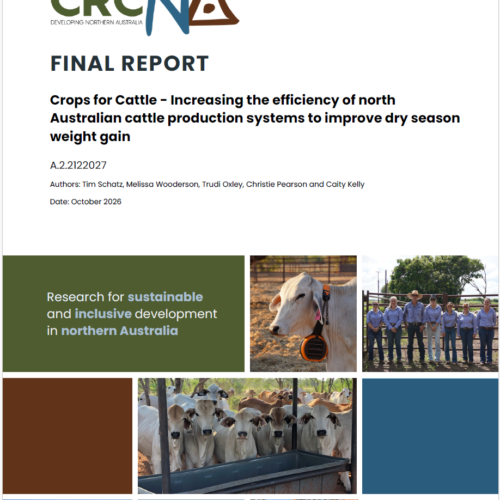
- Author Tim Schatz, Melissa Wooderson, Trudi Oxley, Christie Pearson and Caity Kelly
- Publish date 30 October 2026
- Type Report
- ISBN 978-1-922437-96-9
- Documents
- Cotton Grains Cattle program
- Beef
- Broadacre cropping
Summary
This final report presents the findings of the CRCNA’s Crops for Cattle NT project, delivered as part of the Integrated Farming Systems – Cotton, Grains and Cattle Program.
The report examines dry-season cattle feeding trials, livestock growth performance and economic modelling across a range of northern production systems. It also details three virtual fencing trials investigating opportunities to improve grazing distribution, protect degraded landscapes and support precision grazing.
The findings provide northern beef producers with practical evidence to inform feeding, investment and grazing management decisions, while identifying opportunities and limitations for improving productivity and profitability.
Projects

Cotton Grains Cattle program: Crops for Cattle
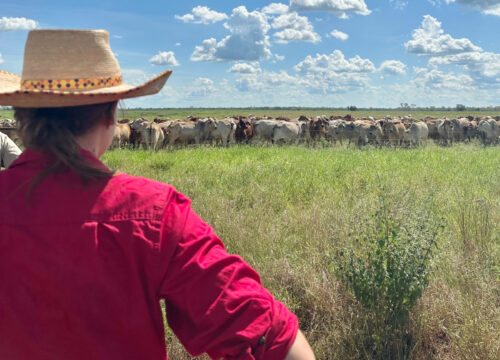
The Crops for Cattle NT project investigated opportunities to improve cattle productivity, dry-season feeding strategies and grazing management across northern Australia. The project formed part of the CRCNA’s Integrated Farming Systems – Cotton, Grains and Cattle Program, which explored opportunities to strengthen connections between cropping and livestock production, improve productivity and support agricultural diversification across northern Australia. Delivered in partnership with the Northern Territory Department of Agriculture and Fisheries and commercial producers, the project combined feeding trials, economic modelling and virtual fencing demonstrations. Research evaluated grain and pellet supplementation, forage sorghum, irrigated pastures, floodplain grazing and silage-based feeding systems. While some strategies demonstrated positive gross margins, economic modelling highlighted that improved liveweight gain does not always translate into greater whole-of-herd profitability. Three virtual fencing trials demonstrated the technology’s potential to improve grazing distribution, protect degraded areas and enable controlled strip grazing under irrigation. Cattle showed high levels of compliance with virtual boundaries following initial training, providing valuable insights into opportunities for more precise livestock and pasture management. The completed research provides northern beef producers with practical data to inform feeding and investment decisions, alongside new evidence supporting the potential adoption of virtual fencing technology in northern grazing systems. Project publications: Phelps K, Schatz T (2024) Crops for Cattle – Increasing the efficiency of north Australian cattle production systems through using local crops to improve dry season weight gain. Proceedings of the 35th Biennial Conference of the Australian Association of Animal Sciences and the 20th Asian-Australasian Association of Animal Production Societies Volume 35 p 141. Pearson C, Chang A (2026) Virtually fencing cattle onto new water points in Northern Australia. Proceedings of the Northern Beef Research Update Conference, Brisbane, Qld, 10-13 March 2026. P 74. https://ef5c27eb-0173-4e59-8bc2-fec4ed126de5.filesusr.com/ugd/f995e2_2efca15b7ce84c3c824e8770d0ebd80f.pdf Schatz T, Wooderson M, Weir Z (2026) Crops for Cattle – Increasing the efficiency of north Australian cattle production systems through strategies to improve dry season weight gain. Proceedings of the Northern Beef Research Update Conference, Brisbane, Qld, 10-13 March 2026. P. 62 https://ef5c27eb-0173-4e59-8bc2-fec4ed126de5.filesusr.com/ugd/f995e2_2efca15b7ce84c3c824e8770d0ebd80f.pdf