

- Author James Cook University
- Publish date 30 June 2022
- Type Fact sheet
- Documents
- Aquaculture
Summary
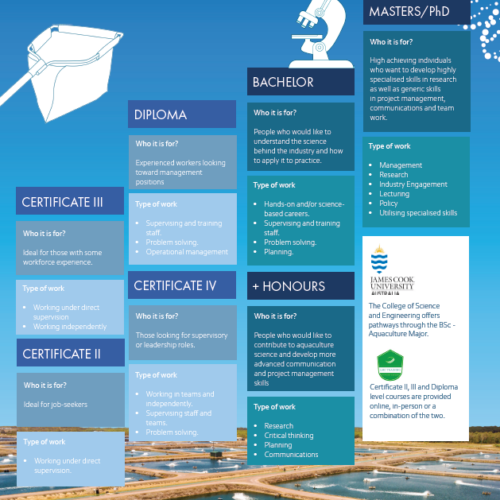
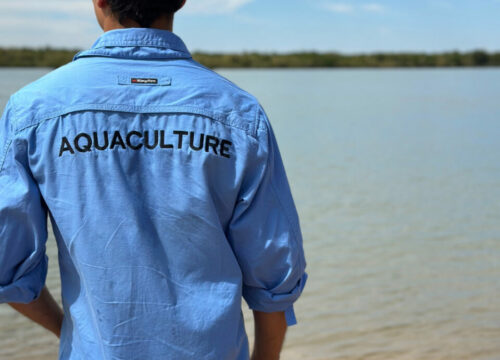
As part of the Future-proofing the Northern Australia aquaculture industry need for skilled staff to 2050 project, researchers developed a suite of information and educational materials which could be used to help promote a career in aquaculture and deliver core components of training.
Projects

Future-proofing the NA aquaculture industry need for skilled staff to 2030
The northern Australia aquaculture industry will require between 1400 and 2300 new skilled staff by 2030 to support projected industry growth. The CRCNA’s Northern Australia aquaculture situational analysis identified key challenges, including a shortage of domestically skilled and experienced aquaculture staff, and the need to build capacity in on-farm biosecurity and health management across the region. The report captured producers concerns about the need to build workforce capabilities to meet industry growth, including professional development for current staff, aligning training with industry needs, and promoting career opportunities in aquaculture among regional communities. This project defined the specific skills and education levels required by the industry, mapped existing training and education providers, and proposed improved models for education and training delivery. By evaluating current and future workforce needs and analysing the gap between industry demand and educational output, the project identified career pathway gaps that must be addressed to meet future requirements. These career pathways formed the basis of promotional tools created to highlight education and skills development options for secondary students interested in entering the aquaculture industry. Cost-effective training delivery models were a key for outcome of the project, and a pilot project to upskill existing industry employees in biosecurity will be used to develop and streamline new training delivery models. The immediate and short-term benefits of the project included: Increased biosecurity awareness and disease responsiveness. More refined training and education approaches for aquaculture. Greater awareness of career prospects to attract new people to the sector. These outcomes helped establish mechanisms to significantly improve the chance of achieving the long-term outcome: a future-ready workforce that meets industry demand. The project involved comprehensive communication with stakeholders and the timely sharing of all outputs. Participants and stakeholders directly applied the research findings to: Inform cost-effective training and education strategies. Recruit new students into aquaculture career pathways. Implement on-farm training to enhance productivity and contribute to GDP growth. The project provided value to the northern Australian aquaculture industry across several areas: Provided education providers with documentation outlining the skills sets required of graduates, helping shape course outcomes. Supplied data on future capacity requirements for education providers to guide course sizes aligned with industry expansion goals. Offered evidence and clear pathways to meaningful careers for students in the later stages of secondary education. Collectively, these efforts resulted in workforce education that more closely matches with industry demand for qualified personnel. The projects outputs are also expected to inform strategic planning processes for education providers, offering evidence-based insights into future needs and directions for growth.
Northern Australia aquaculture industry situational analysis study
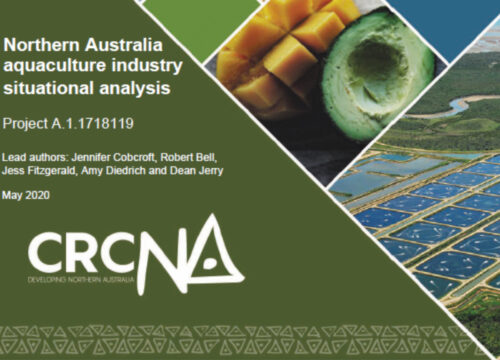
The objectives of this project were to identify key challenges and opportunities facing the northern Australian aquaculture sector, and to explore potential solutions and/or identify the most strategic research projects for further investment. The scope of the study included infrastructure, policy, investment, environmental factors, production, knowledge, training and human capital gaps. This situational analysis examined current industry characteristics – including industry size, production, income, productivity measures and employment levels – to understand capacity and scalability limitations. It included, but was not limited to, an examination of infrastructure, biosecurity, animal health management, the investment landscape, policy, training and human capital gaps, and the research or alternative solutions to address these issues. A Northern Aquaculture Industry Vision 2028 was developed as part of this study. This vision and strategy were created in collaboration with Indigenous and non-Indigenous stakeholders, associations, aquaculture farmers, researchers, government and non-government organisations, through a series of focus group sessions. Over 350 participants engaged through surveys, workshops, webinars, and direct communication, ensuring broad industry input. Potential for a fivefold increase in production by 2030, reaching over $1.3 billion GVP annually and creating 1,400–2,300 new jobs.