

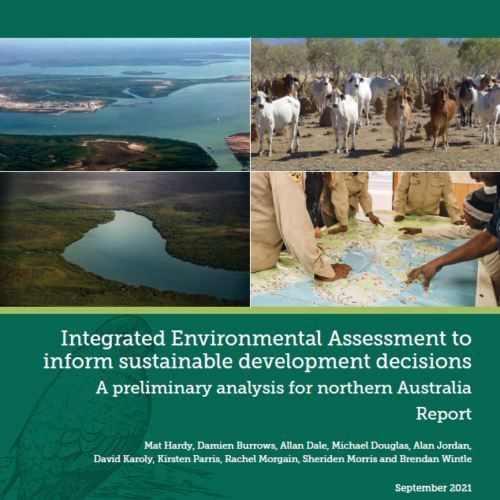
- Author Hardy, M., Burrows, D., Dale, A, Douglas, M., Jordan, A., Karoly, D., Parris, K., Morgain, R., Morris, S., White, B.
- Publish date 30 September 2021
- Type Report
- Documents
- Strategic policy development
Summary
Integrated environmental assessment (IEA) is a policy-orientated process for combining information from diverse knowledge systems to inform decision-making.
This technical report explores Integrated Environmental Assessment (IEA) as an approach with significant potential to improve the delivery of sustainable development in northern Australia. IEA is an interdisciplinary and policy-orientated process for combining information from diverse scientific disciplines and knowledge systems to inform and enhance decision-making. IEA helps close decision-making, data and engagement gaps between higher level legislative requirements and on-ground project assessment and approval. The ability of IEA to synthesise and analyse information from multiple knowledge systems at relevant scales makes it particularly useful for informing development decisions in large, contested areas that contain high biodiversity and cultural values. As one example, products arising from the IEA process could integrate with and inform landscape-scale and regional planning, helping to identify areas where development, cultural and environmental conservation values overlap, compete or complement, and facilitate exploration of scenarios of environmental and development futures.
This report explores an IEA process framework for Australia, and offers a preliminary analysis of using IEA in Northern Australia. Drawing on current knowledge and experience in IEA, this technical report explores a broadly applicable IEA process framework for conducting IEA in Australia. The report provides a preliminary analysis of using IEA in northern Australia, stepping through each stage of an example IEA process framework. This is not a report on an actual IEA process, rather a scoping document with the objective of highlighting how the IEA approach could inform and improve sustainable development decisions in Australia.
Projects

Leading CRCNA’s De-risking and supply chain investment and impact
Drawing on the foundational research delivered as part of the CRCNA’s first phase of de-risking work across Queensland, the Northern Territory and northern Western Australia, this project provides the leadership, coordination, research synthesis and policy impact behind the CRCNA’s Phase 2 de-risking and supply chain development program investments. The key research activities to be undertaken in this project include: synthesising and promoting key policy and investment impact implications from the Phase 1 de-risking and supply chain development R&D investment supporting the development of, and guiding the successful completion of, targeted research investments in all three jurisdictions under the de-risking and supply chain development program synthesising and exploring further policy and investment options emerging from common research findings from overall investments across the Program. The key research methods applied within the project include: literature-based synthesis of existing and new R&D findings and from the relevant international literature the participative and deliberative co-design of the program and its constituent sub-projects the establishment of a strong program and sub-project governance arrangements to maximise research impact.