

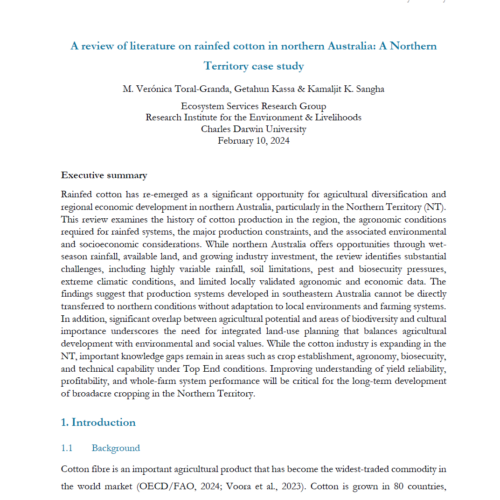
- Author M. Verónica Toral-Granda, Getahun Kassa & Kamaljit K. Sangha
- Publish date 10 February 2024
- Type Literature review
- Documents
- Cotton Grains Cattle program
- Broadacre cropping
Summary
This literature review examines the potential for rainfed cotton to support agricultural diversification in northern Australia, with a focus on the Northern Territory. It assesses the agronomic, economic, environmental and social factors shaping the viability of a rainfed cotton industry, drawing on historical experience, current industry developments and existing research.
The review finds that while northern Australia offers opportunities through wet-season rainfall, available land and growing industry investment, significant constraints remain. These include highly variable rainfall, poor soil fertility and water-holding capacity, extreme climatic conditions, pest and biosecurity risks, and limited locally validated production data. It also highlights broader considerations, including biodiversity impacts, land clearing emissions, cultural values and the need for integrated land-use planning.
Overall, the report concludes that rainfed cotton may offer economic opportunities in the Northern Territory, but long-term viability will depend on further research, locally adapted farming systems, careful environmental management and stronger evidence around profitability, sustainability and whole-of-system performance.
Projects
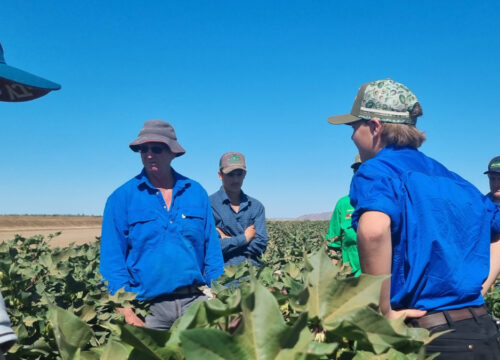

Cotton Grains Cattle program: Addressing the fundamentals of cropping-systems in the Northern Territory
Improving the productivity and profitability of the Northern Territory’s cropping system is crucial for the sustainable growth of the regions agriculture sector. Current research and development efforts, along with major infrastructure investments, are supporting the establishment of a self-sustaining cotton industry in the Top End. However, significant knowledge gaps remain in areas such as crop establishment, agronomy, biosecurity, technical skills, and the social factors that present barriers to the growth of broadacre cropping in the Northern Territory. These gaps must be addressed for the sector to fully realise its potential. This project will integrate cropping trials with efforts to characterise and map soil types and water-holding capacity at participating trial sites, as well as in new potential cotton-growing areas across the Northern Territory. Scenario planning will also be conducted to better understand the economic and environmental impacts of the project’s recommendations. Practice change, guided by the knowledge co-generated throughout the life of the project, will lead to sustainable social, environmental, and economical impacts. Specific outcomes include: Growers confidently adopting crop establishment recommendations for reliable production. Growers making informed decisions on crop rotation and cover crops to maximise production and profitability. Growers making informed and conscious decisions regarding nutrition application and the selection of integrated pest management (IPM) strategies for insect and disease control. Current growers and potential investors in the Northern Territory having access to adequate information for selecting suitable crops for new establishments. Growers having access to a decision-making toolkit that supports investment in the industry, including risk management planning. Aboriginal land councils, Aboriginal development corporations, and Indigenous communities being supported through access to information that informs investment in broadacre cropping, capacity building, and other identified needs. The scientific and commercial communities accessing trusted information from the project’s trials. The Northern Territory cotton industry having access to tailored training materials for ongoing reference and capacity building. Publications Scoping mushroom cultivation in the Northern Territory: Applying a circular economy approach https://www.sciencedirect.com/science/article/pii/S294975072500104X Challenges and prospects of cotton farming in the tropics: lessons for northern Australia https://link.springer.com/article/10.1186/s42397-025-00249-7