

The Jardine River Catchment, located at the northern tip of Cape York Peninsula, is a region of immense cultural, environmental, and economic significance. Under the Water Plan (Cape York) 2019, about 485,000 megalitres, has been reserved for Aboriginal and Torres Strait Islander peoples.
In the Jardine Catchment alone, a substantial 49,000 ML of water is allocated to Aboriginal and Torres Strait Islander communities through the Cape York Peninsula Heritage Area (CYPHA) reserve, aimed at fostering social and economic development. However, turning this opportunity into real benefits is not easy.
A recent case study by The Cairns Institute at James Cook University, supported by the Cooperative Research Centre for Developing Northern Australia (CRCNA), explores the opportunities and challenges in activating these water rights to benefit Indigenous communities in the Northern Peninsula Area (NPA).
Through a workshop and interviews with key informants, opportunities and barriers were identified and options for reforms identified to support sustainable development.
Disputed clan boundaries and a lack of decision-making protocols combined with limited resources, and complex statutory processes all make decision-making tough. Many participants in workshops and interviews also highlighted the need for better understanding of the Water Plan and clearer processes for gaining Free, Prior and Informed Consent (FPIC) from Traditional Owners.
Despite the challenges, the study identified immediate opportunities for local communities worth investigating including reviving agriculture to support local food security and bottling of water for retail sale. In the longer-term ecosystem services, municipal and mining uses were also identified as potential opportunities by workshop and interview informants.
The case study considers options to overcome these barriers:
1. Governance Capacity Building: Long-term investment in a place-based facility to support Indigenous corporations and clans with governance capacity including training, dispute resolution, and planning services.
2. FPIC Protocols: Developing agree decision-making protocols that support customary clan decision making within Indigenous corporation governance structures to streamline water rights activation.
3. Corporate Rationalization: Options include rationalising Registered Native Title Body Corporates and Trustees of Aboriginal Freehold where they represent the same people into a single entity or splitting them along clan boundaries to simplify governance.
4. Statutory Reforms: Statutory reforms to stream line assessment processes are also proposed where community aspirations for development are agreed.
A Path Forward
Immediate opportunities, such as revitalizing the Bamaga Farm and bottling water, could deliver economic, social, and health benefits within the existing community footprints. In the long term, coordinated investment in governance, regional planning, and environmental markets could unlock the full potential of CYPHA water reserves. By addressing governance and statutory barriers, Indigenous communities in the Jardine Catchment can lead sustainable development that honours their cultural heritage and supports economic self-determination.
Jim believes that “The Jardine case study highlights that activating Indigenous water rights is not just about economics, it’s about governance, culture, and self-determination. By strengthening local institutions and planning for the future, Traditional Owners can turn water rights into lasting community and environmental benefits.”
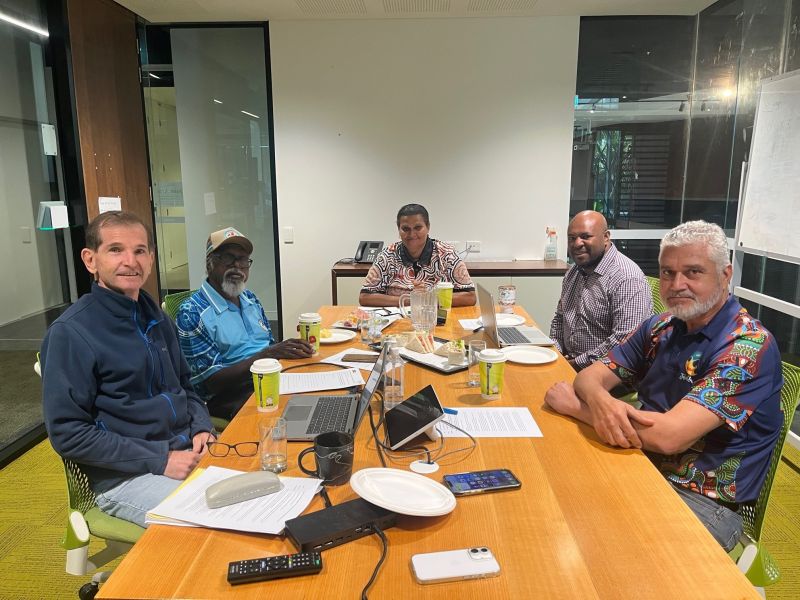
Image: First Nations Reference group meeting for Cape York Water Project. (l-r) Dr Jim Turnour, Johnson Chippendale, Fanny Solomon, Dr Abner Yalu and Conrad Yeatman.
November 2025
