

- Author Canning, Adam
- Publish date 21 May 2025
- Type Report
- Documents
- Water: Making Water Work program
Summary
This literature review examines the potential to transform invasive water hyacinth from a problematic aquatic weed into a productive agricultural input, supporting more circular approaches to nutrient, waste and energy management in agricultural development. Drawing on international research, it evaluates the use of water hyacinth as mulch, compost, biochar and foliar extracts, assessing impacts on soil health, nutrient availability, crop productivity and microbial activity. The review identifies promising opportunities to recover nutrients, reduce reliance on synthetic fertilisers and lower environmental impacts, while also highlighting practical constraints including harvesting logistics, contamination risks and the need for long-term field validation before large-scale adoption.
Raw data open set: Raw data for: ‘Water hyacinth (Eichhornia crassipes) mulch and urea interactions shape soil biota and nitrogen cycling‘ – https://researchportal.scu.edu.au/esploro/outputs/dataset/Raw-data-for-Water-hyacinth-Eichhornia/991013338487402368
Projects

Making Water Work: Integrating nutrient, waste and energy streams in agriculture development through hyacinth harvest and processing
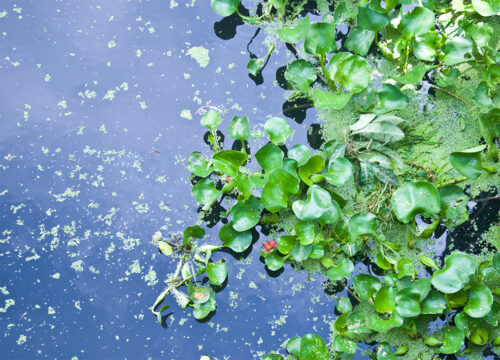
This project investigated how invasive water hyacinth in the Fitzroy River could be transformed from an environmental management challenge into a productive agricultural resource. Originally introduced to Central Queensland as an ornamental plant, water hyacinth has become a significant aquatic weed due to its rapid growth, dense biomass and long-lived seed bank, reducing waterway health, impacting ecosystem condition and creating ongoing management costs for land managers and local councils. The project explored practical pathways for harvesting and reusing water hyacinth biomass, with a focus on its potential as a soil ameliorant for agricultural production in the Lower Fitzroy region. By removing nutrient-rich biomass from the waterway, the project also examined opportunities to reduce nutrient loads in the Fitzroy catchment, improve water quality flowing to the Great Barrier Reef and support healthier aquatic ecosystems. Research findings highlighted strong potential for water hyacinth to be repurposed into agricultural products such as compost, mulch and biochar, reducing reliance on imported soil amendments while supporting more circular approaches to land and water management. The project also assessed the economic feasibility of different beneficial end uses, including a cost-benefit analysis of harvesting and processing pathways to identify realistic implementation opportunities. By linking invasive weed management with nutrient recovery and agricultural development, the project provides a practical model for turning an environmental liability into a productive resource, with potential benefits for water quality, farming productivity, waste reduction and regional resource efficiency across northern Australia.