

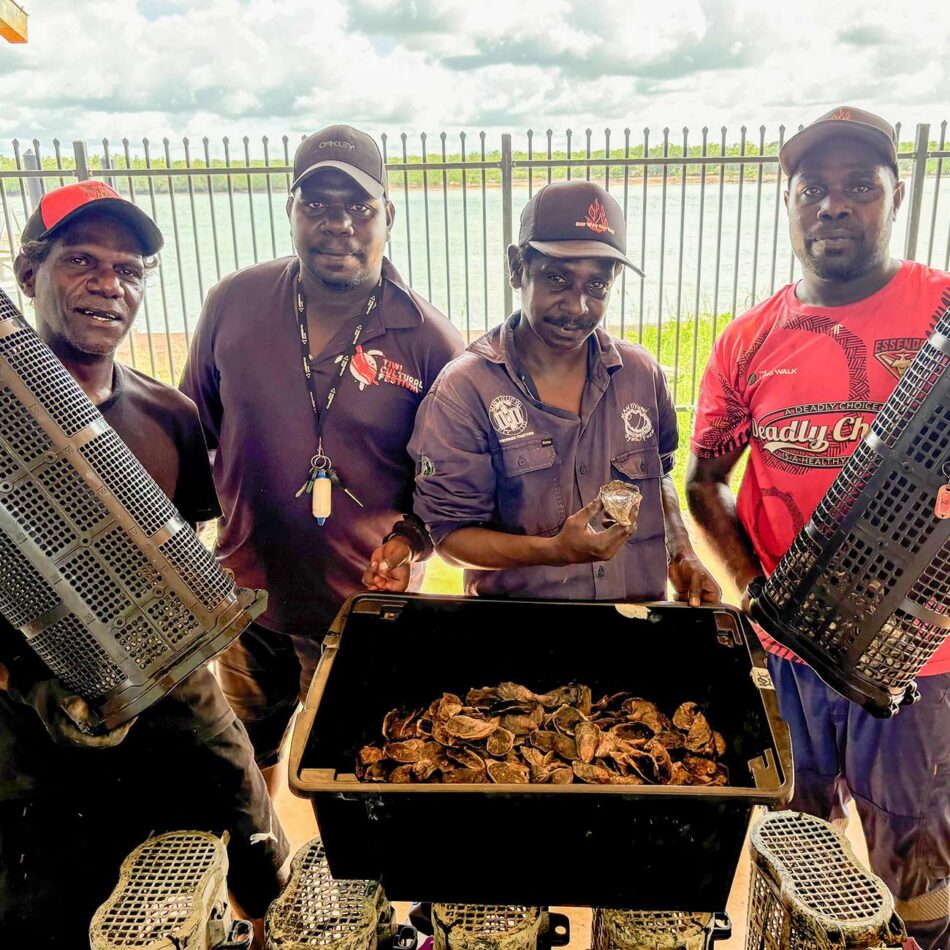
Indigenous communities across the Northern Territory have been working in collaboration with the Northern Territory Government to establish a commercially viable oyster farming industry built around native species and local opportunity.
The first commercial sales of Northern Territory farmed blacklip rock oysters are expected soon, following years of research and industry development.
Cold storage built for the tropics
Research supported by FRDC and led by Charles Darwin University examined whether tropical oysters could be safely transported through existing seafood supply chains.
The study found that at 4°C, Vibrio parahaemolyticus, a bacterium associated with foodborne illness, did not grow. This provided important evidence that tropical oysters could be managed through existing cold storage systems.
Samantha Nowland, Senior Aquaculture Research Scientist at the Darwin Aquaculture Centre, said the findings were significant for the emerging industry.
“For a new sector, that’s huge,” she said. “It means producers don’t need to reinvent the supply chain and that tropical oysters can sit alongside other seafood products and meet the same standards.”
Rethinking site selection
Research also identified the importance of selecting suitable farming locations to meet national food safety standards.
Testing of wild oysters across several Northern Territory locations found that cadmium concentrations exceeded permitted levels in some areas, while other locations recorded concentrations below the threshold.
“The data shows this isn’t a blanket problem,” Nowland said. “Site selection matters, farming matters and time in the water matters.”
An Indigenous-led sector takes shape
Four Indigenous organisations are positioned to transition towards commercial production:
- Yagbani Aboriginal Corporation, South Goulburn Island
- Groote Aqua Aboriginal Corporation, Groote Eylandt
- Mantiyupwi Pty Ltd, Tiwi Islands
- Thamarrurr Development Corporation, Wadeye
The industry is creating opportunities for Aboriginal communities to establish aquaculture enterprises on Country, drawing on local knowledge, marine resources and research partnerships.
“It’s important that we have oyster farming on Country, in our mob’s backyard,” said Guy Mankara, who works on the Tiwi Island farm.
“The crew already love being on the water, getting out onto boats and fishing, but this farm keeps the business side in the community.”
Supported by the Northern Territory Government’s Department of Agriculture and Fisheries, Darwin Aquaculture Centre, Charles Darwin University and the Cooperative Research Centre for Developing Northern Australia, participating organisations are preparing to supply local markets during the dry season, when oysters are in peak condition.
Building future industry capability
Research continues into selective breeding to reduce oyster grow-out times and improve productivity.
Hatchery capability is also transitioning towards Indigenous-owned operations, with Groote Aqua Aboriginal Corporation developing the capacity to supply juvenile oysters, known as spat, to the wider industry.
The research and partnerships established through this work are helping build the foundations for a commercially viable, Indigenous-led tropical oyster aquaculture sector across northern Australia.
Article published by Fisheries Research and Development Corporation (FRDC) 30 March 2026 https://www.frdc.com.au/news/building-tropical-oyster-sector-ground
