
Activating the Indigenous estate – Baseline study of agricultural capacity
- Reference # AT.4.2021117
- Research Programs 4. Activating the First Nations Estate
- Project Timeframe 8 months (2021 to 2022)
- CRCNA Funding $54,801
- Total project value $247,228

- First Nations led business development
- Agriculture
- Aquaculture
- Forestry
Project locations: Western Australia, Northern Territory, Queensland, Canberra
Project partners: Indigenous Land and Sea Corporation ; The Australian National University ; Department of Agriculture, Water and the Environment
Project summary and impacts
This project examined the unrealised agricultural potential of the Indigenous estate across Australia. It aligned with national policy agendas and closely examined agricultural development in northern Australia.
The research assessed opportunities to adjust policy settings to unlock the value and potential of the Indigenous estate and agricultural economy. Key enablers identified include:
- Providing better access to information.
- Building the capability of Traditional Owners.
- Addressing bias and information asymmetries with financial institutions and investors.
- Support agreement-making processes.
These measures could enable increased investment and productivity across Indigenous lands and waters.
Led by The Australian National University (ANU), the project conducted a Situational Analysis to benefit First Nations communities and agricultural stakeholders. It assessed the national economic impacts – including GDP, gross value of production, industry value-add, and employment – of increasing the productivity and profitability of Indigenous land and waters across primary production sectors such as agriculture, forestry, fisheries and aquaculture, as well as emerging markets for carbon and biodiversity credits.
The baseline study sets the foundation for further engagement with First Nations communities to unlock the agricultural production potential of the Indigenous estate. The Situational Analysis involved desktop research using existing data to:
- Map the bio-cultural assets of the Indigenous estate (e.g. land use, tenure, water).
- Establish a baseline of the nature, size, and value of primary production within the Indigenous agricultural economy.
- Identify infrastructure and resource gaps using a System of Environment-Economic Accounting to support cost-benefit analysis for investment.
- Apply GIS-based Multi-Criteria Evaluation to generate scenario-based outputs weighted by priorities (e.g. water access, productivity, tenure, conservation).
- Develop a range of land use scenarios (low, medium, high conversion over 10 and 20 years), presented via an interactive dashboard.
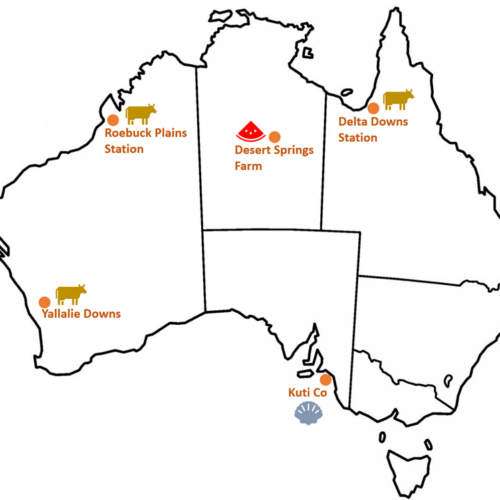
- Prepare case studies of current regional agricultural investments on the Indigenous estate.
The key output from the research was a peer-reviewed published report and summary, which is now used to inform a broad range of stakeholders on public policy and future research interests.
The research outcomes have influenced a variety of policy and program areas across government, industry, and First Nations communities.
Key impacts include:
- First Nations communities and organisations now have access to information that supports greater understanding and strategic planning around the productivity and profitability of primary production using their lands and waters.
- The findings have informed the strategic objectives of CRCNA in relation to activating the Indigenous estate in northern Australia.
- The research has also supported the strategic objectives of the Indigenous Land and Sea Corporation (ILSC) for activating the Indigenous estate across Australia.
- The project contributes to national policy agendas, including the National Agreement on Closing the Gap, Northern Australian Development, and the National Water Initiative.
- It responds to and informs, the five pillars of the National Farmers’ Federation (NFF) 2030 Agricultural Roadmap, particularly the inclusion and activation of the Indigenous estate.
- The research facilitates and strengthens partnerships between First Nations organisations, the ILSC and the NFF to support agricultural development of Indigenous lands.
- It provides a platform for new research and encourages First Nations community interest in activating their land for agricultural purposes.
Publications

1 July 2026
Impact report: Activating the Indigenous Estate
Type: Report
Industry: First Nations led business development

18 August 2022
Baseline study – Agricultural capacity of the Indigenous Estate Case Study Report
Type: Case study
Industry: First Nations led business development, Strategic policy development
18 August 2022
Baseline study – Agricultural capacity of the Indigenous Estate
Type: Report
Industry: First Nations led business development, Strategic policy development